
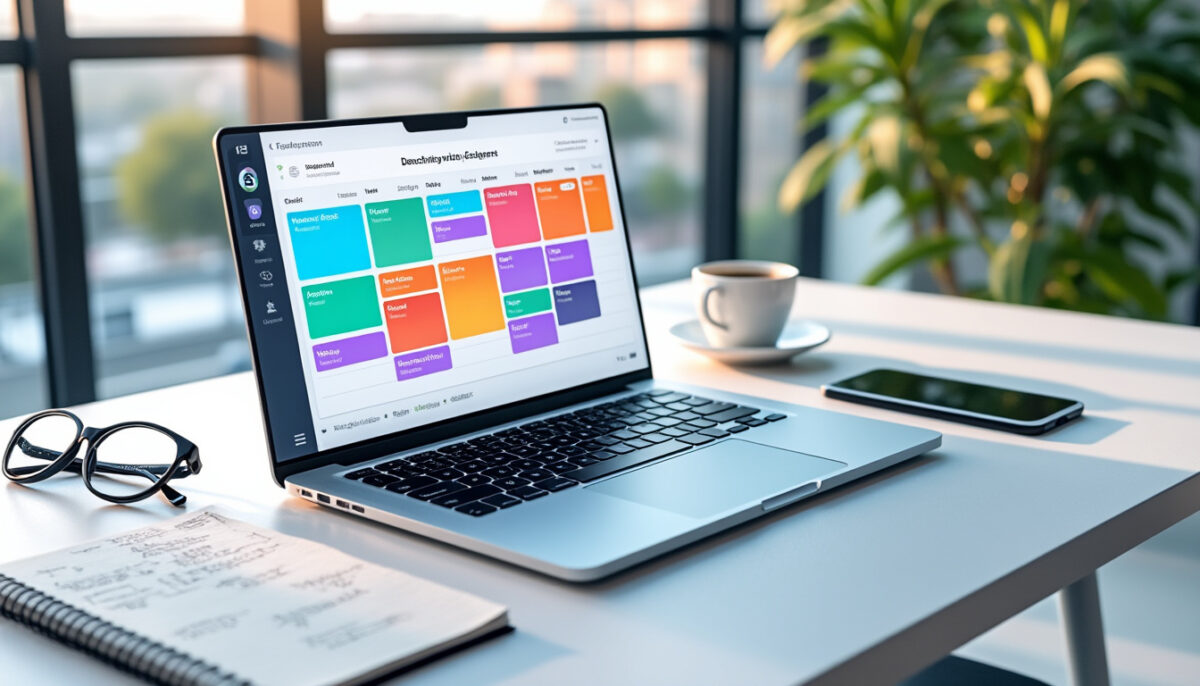
Organization for freelancers: this time block changes everything
Hi everyone, Mila here. The key to boosting your productivity as a freelancer is to structure your day around a specific time block dedicated to deep work, often in the middle of the morning. This intense, protected slot helps maximize efficiency without multiplying distractions.
WHAT TO DO RIGHT AWAY
- Identify your peak concentration time during the day (chronotype).
- Schedule a time block dedicated to complex tasks without interruptions.
- Group less demanding tasks into periods when your energy is lower.
- Set aside time slots for unexpected issues and client communications.
- Apply the 2-minute rule to handle immediate micro-tasks.
Before organizing your schedule, figure out which organizational rhythm truly works for you. Every freelancer is different, and learning to make the most of your own chronotype — whether you’re a morning, intermediate, or evening type — already turns time management into an advantage. This resource explains how your schedule can hold you back and why aligning your schedule with your natural energy is essential. The Time Blocking method provides just the structure that frees up your autonomy.
Why structuring a time block changes everything for freelancers
In 2026, freelance productivity remains a challenge, because the lack of a rigid framework also drains energy. Without a manager or fixed hours, multitasking becomes a common trap that scatters your attention between prospecting, client management, and production. So it’s not about working more, but working better by making full use of a time slot dedicated to high-value tasks.
A time block eliminates multitasking, limiting the average loss of 23 minutes caused by each interruption—which can be seen as a real theft of cognitive time. Understanding which time slots to prioritize helps multiply your ability to concentrate.
Three steps to build an effective time block into your routine
- Step 1: Identify your natural rhythm. Notice when you feel calmest and clearest; for most people, this is between 10 a.m. and 1 p.m.
- Step 2: Block out a 90-minute period when you eliminate all distractions (notifications off, phone on silent, dedicated workspace).
- Step 3: Commit to staying in this block until it ends, focusing specifically on complex or creative, high-value tasks.
Routine and discipline: your foundation for efficiency as a freelancer
A freelancer’s success depends on well-established routines. A short morning routine, for example, that includes reviewing your three priority tasks, sets the tone for your day. Many fall for the illusion of “working hard” without a method, until they burn out. A schedule built around a solid time block is the best answer to this.
Moreover, the discipline of applying techniques such as batching to group your administrative tasks into specific periods helps protect this precious block dedicated to deep work. If you want to improve your time management, check out these tips on freelance time management: they’ll help you avoid overload and organize your week more effectively.
Checklist for organizing your day around a single productive time block
- Prepare your weekly schedule with a focus on this block (time block).
- Turn off all notifications during this slot.
- Handle emails and simpler tasks outside this time slot.
- Always schedule a break right after the block.
- Clearly communicate your availability to your clients.
Comparing effective organization methods for freelancers
| Method | Ideal for | Limitations | Difficulty |
|---|---|---|---|
| Time Blocking | Freelancers managing multiple projects who need to concentrate | Not very flexible when unexpected emergencies arise | Medium |
| Batching | Administrative and repetitive tasks | Difficult when instant feedback is needed | Low |
| Adapted Pomodoro | Demanding tasks and combating procrastination | Can interrupt creative flow | Low |
| Eisenhower Matrix | Weekly prioritization | Less suitable if tasks are poorly sorted | Low |
Take care of your workspace and your concentration
Your physical workspace plays a key role in your autonomy and discipline. Working from a dedicated desk area, with a good chair and natural light, reduces hidden distractions. This is often overlooked, but it’s essential for strengthening your professional organization as a freelancer.
In addition to time blocking, taking regular breaks using the Pomodoro method (50 to 90 minutes of intense work followed by a break) is essential for going the distance without pushing yourself too hard. The importance of a real break between your personal life and your freelance work cannot be overstated. This time slot is the key to saving your day.
How many hours should a freelancer aim to work each day?
There is no universal number, but working around 5 to 6 effective hours, including at least 4 hours of deep work, is often more efficient than long, fragmented workdays.
Which method should a beginner freelancer adopt first?
Starting by using batching to group administrative tasks has an immediate impact on time management, before gradually introducing time blocking.
Should you use a time tracking tool?
Time tracking is useful at first to find out where your time goes, but tracking it too closely becomes counterproductive. Tools such as Toggl Track allow you to track your time occasionally.
How can you stay motivated when working alone?
Motivation fluctuates. The best strategy is to establish solid routines, create a conducive environment, and regularly plan achievable goals.
How should you handle urgent client requests?
Learn to say no or negotiate these urgent requests by setting clear boundaries and offering specific times for communication. This protects your organization and discipline.
Thank you so much for reading; Mila. I’d be delighted if you left a comment at the bottom of the page, thank you!